Beyond Lewis Acidity: Thiophilicity and Redox Stability as Design Principles for Sulphur-Containing Polymerisation Catalysis
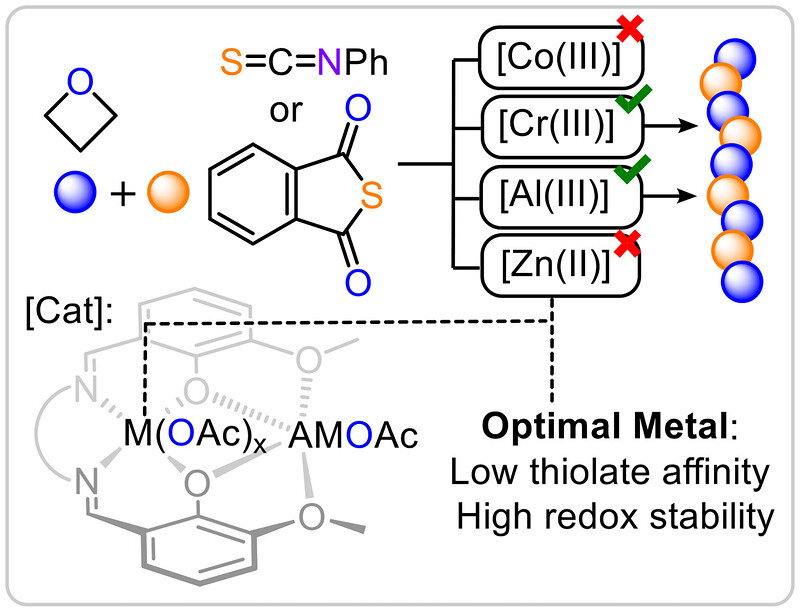
Catalysts for the ring-opening copolymerisation (ROCOP) of sulphur-containing monomers are almost invariably inherited from all-oxygen chemistry, where performance tracks the barrier of the rate-determining propagation step. We show that this transfer fails. The activity of Cr(III), Co(III) and Zn(II) complexes of a common salicylimine scaffold cannot be explained by computationally tracking monomer insertions and metal activity is better predicted off-cycle. A revised experimentally supported computational hypothesis implicates metal thiolates, generated by side-reactions at the chain end, to deactivate the catalyst by either binding too tightly to or reducing the metal centre. The resulting computational descriptors, thiophilicity and redox stability, are distinct from Lewis acidity and chemical hardness, and predicted Al(III) to be competent. Al(III) catalysis delivers recyclable sulphur-containing copolymers with a high apparent weight of Mn = 238.6 kg/mol. This unlocks previously underexplored processing methods for these types of materials such as melt-spinning and scCO2-foaming. Our results suggest new structure–activity design rules for sulphur-containing polymerisation catalysis which are urgently required to obtain technologically useful materials.